Mahboubeh Pahlevan noudeh . Tarannom Taghavi
Reflection of Iranshahri discourse in Qajar school murals
"Case study: murals of heroic themes in the period of Fath Ali Shah"
abstract
The emergence of Iranshahri ideas and attention to ancient and national issues in the first period of the Qajar school causes the appearance of an image that its roots can be traced along the identity of Iranian history and hidden thought in the Aryan essence of religious, epic and mythical texts. The Iranshahri thought of the Qajar school, as a governmental-national discourse along with the Islamic-Shiite discourse and modernity, seeks help from visual reminders that are rooted in the themes of Iranian heroism and myth.
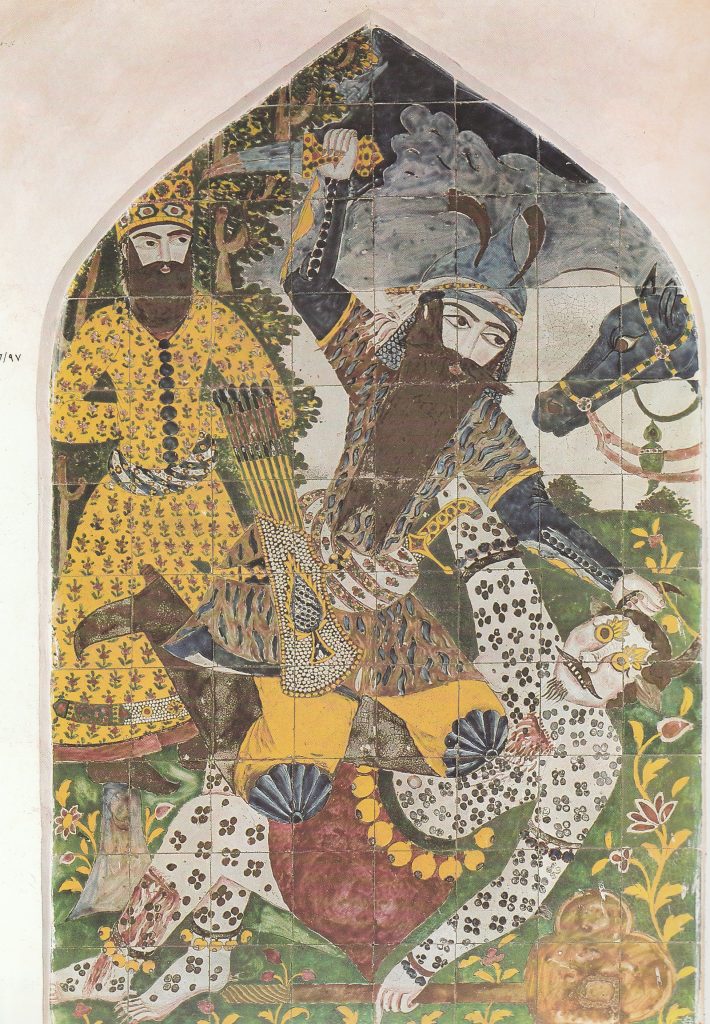
The purpose of this scientific research is to study the discourse and iconography of public space murals under Iranshahri thought and to investigate the reasons for the reflection of this discourse in heroic-mythical subjects. The type of research in terms of purpose is fundamental-theoretical; It is based on the studies of Iranshahri thought and the history of Qajar period with descriptive and analytical methods. Visual antitype are murals of public space with a focus on heroic icons, especially the image of Rostam and the king, And investigated why these issues have been captured.
Studies show that intertextual visual references in murals, with mythical meanings and reflections of the hero in the character of the king in public places, is a request for continuous visual power in any period of Iranian history, according to the concept of national unity. Therefore, the Qajar school mural is a powerful propaganda medium to show nationalism and the image of the king, as a symbol of unity in the diversity of all ethnic groups, is given to Rustam as a symbolic body to express the ideal meaning of the king of God known in Iranian thought.
Keywords: Mural, Qajar school, Iranshahri discourse, championship icon, Fath- Ali shah.
DOI: 10.22070/NEGAREH.2020.1169
Link: http://negareh.shahed.ac.ir/article_1169.html